
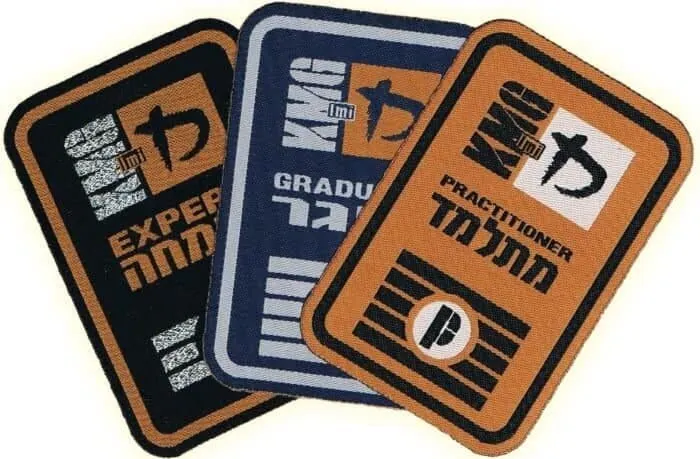
Krav Maga students can take part in gradings, and those who pass earn a Krav Maga level. These levels show how well prepared the student is. We do not use the belt system typical of traditional martial arts, but of course we mark the different levels too. Instead of coloured belts we use patches, worn on the left leg of the trousers. Below we present how the Krav Maga levels are divided today, how this division took shape over the past few decades, and how grading works with us.
The history of the Krav Maga levels
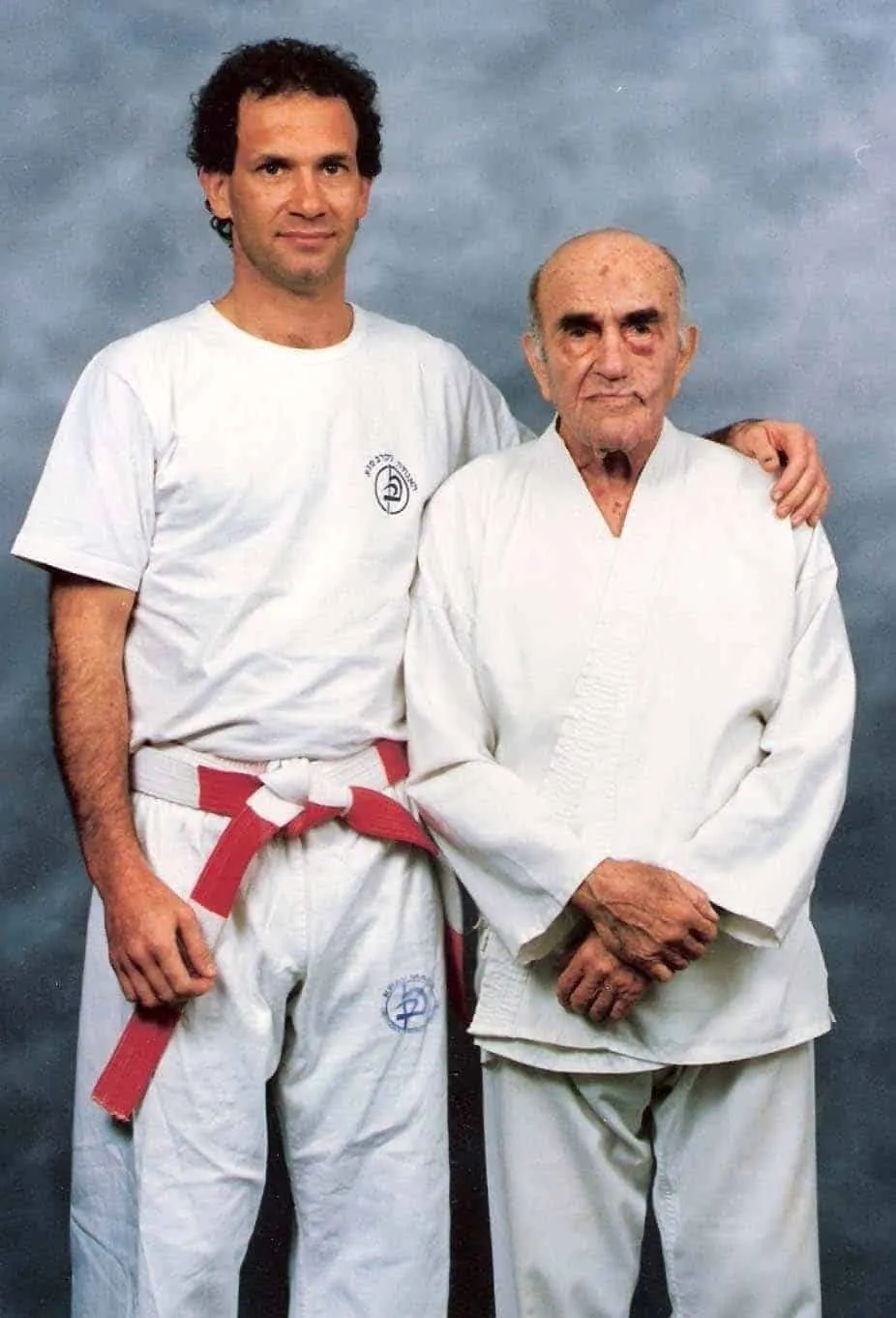
Imi retired from military service in 1964 and started teaching Krav Maga to civilians. You can read more about this here. In the early period he did not distinguish grades yet, and his students wore a simple camouflage T-shirt, the Krav Maga uniform of the time. Not much later he switched to the clothing and belt system known from judo. He created seven grades, to which he assigned the white, yellow, orange, green, blue, brown and black belts.
In 1987 Imi asked Eyal Yanilov to systematize the Krav Maga curriculum. At that time Eyal kept the belt system but extended the levels all the way to Expert 5 (5th dan black belt). Around then more and more young instructors started wearing T-shirts instead of the judo suit (gi). While teaching in Europe and the United States it became obvious to Eyal that the customary clothing and belt system was no longer as practical as before.
As a result of these experiences, in the second half of the 1990s, with Imi's approval and the help of a few European instructors, Eyal reworked the earlier curriculum and created the new system of Krav Maga levels that we still use today.
Krav Maga levels today
Today we distinguish 18 levels in Krav Maga:
- Practitioner (beginner) levels: P1–P5
- Graduate (advanced) levels: G1–G5
- Expert levels: E1–E5
- Master levels: M1–M3 (or E6–E8)
Practitioner (P) levels
Beginner and intermediate levels. The start of a long journey. At the P levels students learn to execute the basic punches and kicks and their combinations, and to defend against the most common unarmed attacks (punches, kicks, chokes and so on). Already at these levels we deal with solving simpler armed (knife and stick) threats and attacks. Students get to know the tactics that can be used against several attackers, and correct decision-making. We put great emphasis on prevention and on the right behaviour before and after a fight.
Graduate (G) levels
Intermediate and advanced levels. G-level students can apply the techniques they learned earlier far more precisely. They can defend correctly and effectively from different starting positions and under higher stress. They get to know more complex attacks and combinations, and learn to defend against more complicated unarmed and armed attacks. At these levels, besides cold weapons (knife and stick), we also teach solutions to various firearm threats. Holding one of the G levels is one of the conditions for a Krav Maga student to become an instructor of Krav Maga Global.
Expert (E) levels
Expert levels, which correspond to the black belt in the traditional belt system. An Expert-level practitioner can perform the P and G level techniques far more precisely, and works equally effectively on the stronger and the weaker side. They can solve rarer, even more complex situations, and have outstanding skills in third-party protection and in fighting techniques and tactics.
There are also three so-called Master levels (Master 1–3, or Expert 6–8), held by only a handful of people in the world. These levels no longer have a specific curriculum. Earning such a level takes a lifetime of persistent and dedicated work. The highest level is currently held only by Eyal Yanilov, founder and chief instructor of Krav Maga Global.
How grading works
To earn the next Krav Maga level you have to take part in a grading organized by Krav Maga Global. The requirements are set by KMG, and the gradings are held by KMG examiners. With us it looks like this:
- Grading is not compulsory. If you just want to train and are not interested in grades, you can come to us for years without grading. The levels are useful because they give a clear goal and make progress measurable, but your self-defense skills do not depend on the patch.
- Two gradings a year. KMG Hungary organizes gradings for the P and G levels in spring and autumn. We always announce the date in class in good time.
- Who can grade? The conditions for taking part in P and G level gradings are the instructor's recommendation, the waiting period and, of course, a suitable state of health. The instructor decides which students to recommend for grading. From P1 to G5 the waiting period for each new grade is six months.
- How long does it take? With two classes a week the first level, P1, can usually be reached in 4–6 months; reaching G1 takes roughly three years of persistent practice. Of course this is different for everyone, and nobody rushes you.
- What do you get after a successful grading? A KMG certificate, the patch of the level, and the KMG Passport, in which every grade you earn is recorded. Your level is valid in any KMG club in the world.
If you are curious how this journey begins, come to a free trial class! It comes with no obligation; all we ask is that you sign up here, so we know you are coming.