
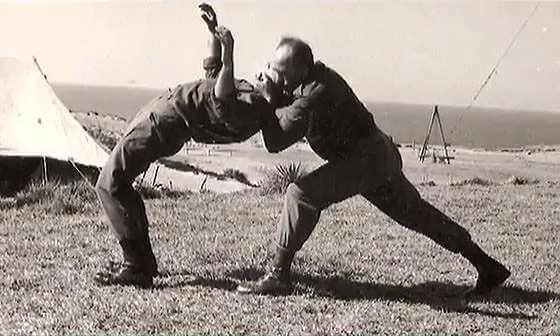
Few people know that the founder of one of the world's most widespread self-defense systems was born in Budapest. The history of Krav Maga starts with a wrestling champion from Bratislava, continues in the Israeli army, and today the system is taught in more than sixty countries, including here in Budapest.
The beginnings
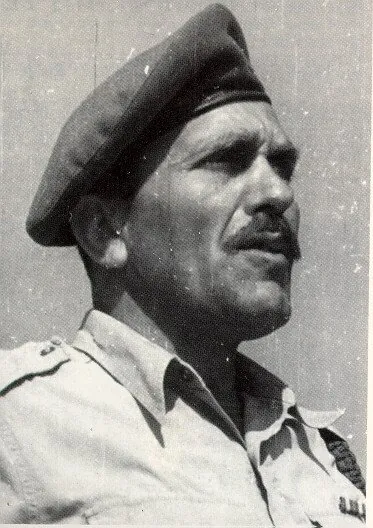
The history of Krav Maga goes back to 1910, when its founder, Imi Lichtenfeld, was born in Budapest. He grew up in Bratislava, where his father, Samuel, was chief inspector of the city police. Part of Samuel's job was to teach self-defense and close combat to his officers, so the young Imi could learn these skills too. Under his father's influence he took up sports at an early age, and it soon turned out that he was an exceptionally talented athlete.
In his teens he did gymnastics, boxing and wrestling. By the age of 19 he was known as a national and international champion in these sports. Later he chose wrestling, and was a member of the Slovak national wrestling team for more than a decade.
The war years
From the mid-1930s fascist and anti-Semitic movements spread across Europe, and with them violence against minorities. Imi became the leader of a group of young Jews who set out to defend the Jewish quarter of Bratislava against anti-Semitic gangs. For four years they took part in many violent clashes and gathered a great deal of experience. The system Imi developed a few years later, which we know today as Krav Maga, goes back to this period.
Be so good that you do not need to kill!
Imi Lichtenfeld
In 1940, as Nazi rule tightened its grip on Europe, Imi left Bratislava. He set off down the Danube towards Palestine on the Pentcho, a river steamer carrying Jewish refugees. The boat broke down in the Aegean Sea and ran aground on an uninhabited island. Imi and a few companions set out for help in a lifeboat; a British warship picked them up and they ended up in Egypt, where Imi spent a long time recovering from a severe ear infection. After his recovery, in 1941 he joined the Czechoslovak legion fighting under British command, and served in North Africa and the Middle East in World War II. He was discharged in 1942 and settled in Palestine, where he trained members of the Jewish self-defense organizations, the Haganah and the Palmach, in close combat.
With the founding of Israel in 1948 the IDF (Israel Defense Forces) was formed. Imi became the army's chief instructor of physical training and Krav Maga. He served in the army for about 20 years and kept refining his method throughout. He personally trained members of Israel's special units, and many Krav Maga instructors too.
The history of civilian Krav Maga

The history of civilian Krav Maga began in 1964, when Imi retired from the army after more than 20 years of service. He decided to shape his vast theoretical knowledge and practical experience into a system that would also hold its own as civilian self-defense. He trained many students and instructors and kept refining Krav Maga, to make it even more effective both as a self-defense system for civilians and as a tactical close-combat system for military and police units.
Eyal Yanilov started learning Krav Maga in 1974, at the age of 15. It soon turned out that he was an exceptionally talented practitioner and teacher. Before long Imi asked Eyal to teach other instructors as well.
In the early 1980s Eyal became Imi's assistant, closest adviser and right-hand man. After graduating as an electrical engineer he began teaching Krav Maga to counter-terrorism units, and together with Imi he wrote the official Krav Maga manual. In the second half of the 1980s Eyal travelled abroad, first to the United States and then to Europe, where he taught military and police units as well as civilians. This is when Krav Maga set out to conquer the world. In 1987 Imi appointed him chief instructor of Krav Maga. In this position Eyal's task was to revise the curriculum and to develop Krav Maga into a system.
In 1996 Imi and Eyal founded the International Krav Maga Federation (IKMF), so that the system could spread around the world even more successfully. Imi then appointed Eyal chief instructor of the federation and awarded him the highest level available (Master 3, or Expert 8). Imi died in 1998, but until his death he was Eyal's mentor, and they refined Krav Maga together. After that Eyal took on the responsibility of developing and spreading the system further.
Today
In 2010 Eyal Yanilov founded Krav Maga Global (KMG), today the largest Krav Maga organization in the world: its curriculum is taught in more than sixty countries. Imi's system is still evolving, because KMG keeps adapting the techniques to today's threats and to the abilities of today's people.
Krav Maga Újbuda is a member of KMG, so with us you learn the same curriculum, progressing through the same level system, as anywhere else in the world. Our instructor trains regularly under Eyal Yanilov and KMG's international team of instructors; you can read more about this on the About page.
The history of Krav Maga in dates
- 1910 – Imi Lichtenfeld is born in Budapest.
- 1930s – Wrestling, boxing and gymnastics champion in Bratislava; with his companions he defends the Jewish quarter against anti-Semitic gangs.
- 1940–1942 – Escape on the Pentcho, service in the Czechoslovak legion, settling in Palestine.
- 1948 – The IDF (Israel Defense Forces) is formed; Imi becomes the army's chief Krav Maga instructor.
- 1964 – Imi retires and starts teaching Krav Maga to civilians.
- 1974 – The 15-year-old Eyal Yanilov starts learning Krav Maga.
- 1987 – Imi appoints Eyal chief instructor of Krav Maga.
- 1996 – The International Krav Maga Federation (IKMF) is founded.
- 1998 – Imi Lichtenfeld dies.
- 2010 – Eyal Yanilov founds Krav Maga Global (KMG).
If this article has caught your interest, you are welcome at a free trial class. It comes with no obligation; all we ask is that you sign up here, so we know you are coming.